
What Wedding Dress Suits My Body Shape? An Honest Guide to Finding the Right Silhouette
One of the questions we hear most often from brides is “what wedding dress suits my body shape?”
It is completely understandable. Before you start trying on wedding dresses, you may already have read guides telling you that pear-shaped brides should wear A-line gowns, hourglass figures should choose fitted dresses, or larger busts should avoid certain necklines.
There is some truth behind certain pieces of traditional bridal advice, but real bodies are far more complicated than a simple body-shape chart.
After more than 20 years of helping brides find their wedding dresses, we know that dress size alone tells us very little. Height, proportions, bust, waist position, torso length, where a skirt begins to flare and the construction of the gown can all make an enormous difference.
That is why we believe in being open-minded, but also realistic.
The aim isn’t to tell every bride that every dress will suit her. It is to work out why one shape works beautifully and another doesn’t, and then find the dress that gives you the best possible proportions.
There Isn’t One Wedding Dress Shape for Your Body Type
If you’re wondering what wedding dress suits my body shape, the answer rarely comes down to one simple rule. Your height, proportions and the way an individual gown is constructed can be just as important as whether you consider yourself pear-shaped, hourglass or curvy.
You may arrive at your bridal appointment convinced that you need an A-line dress because you have fuller hips.
Or you might have seen photographs of fitted gowns and decided that is exactly the look you want.
Both are perfectly reasonable starting points, but the dress itself matters just as much as the name given to its silhouette.
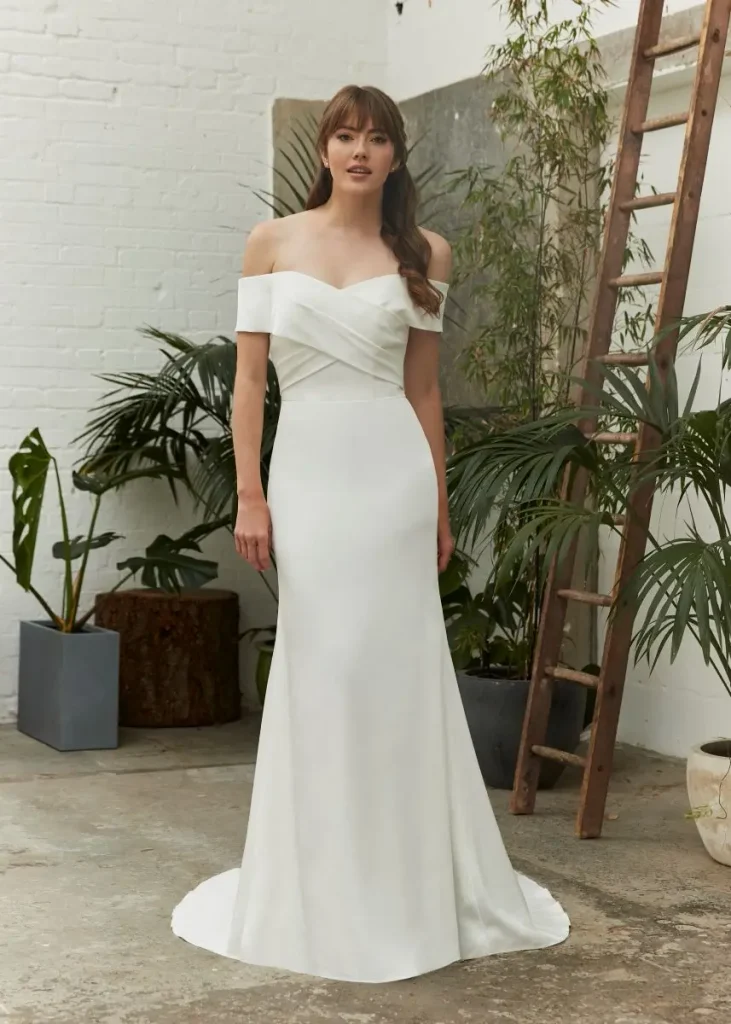
Two gowns described as fit-and-flare can sit completely differently on the body. One may have a long fitted section before dramatically flaring at the knee, while another begins to soften much higher up.
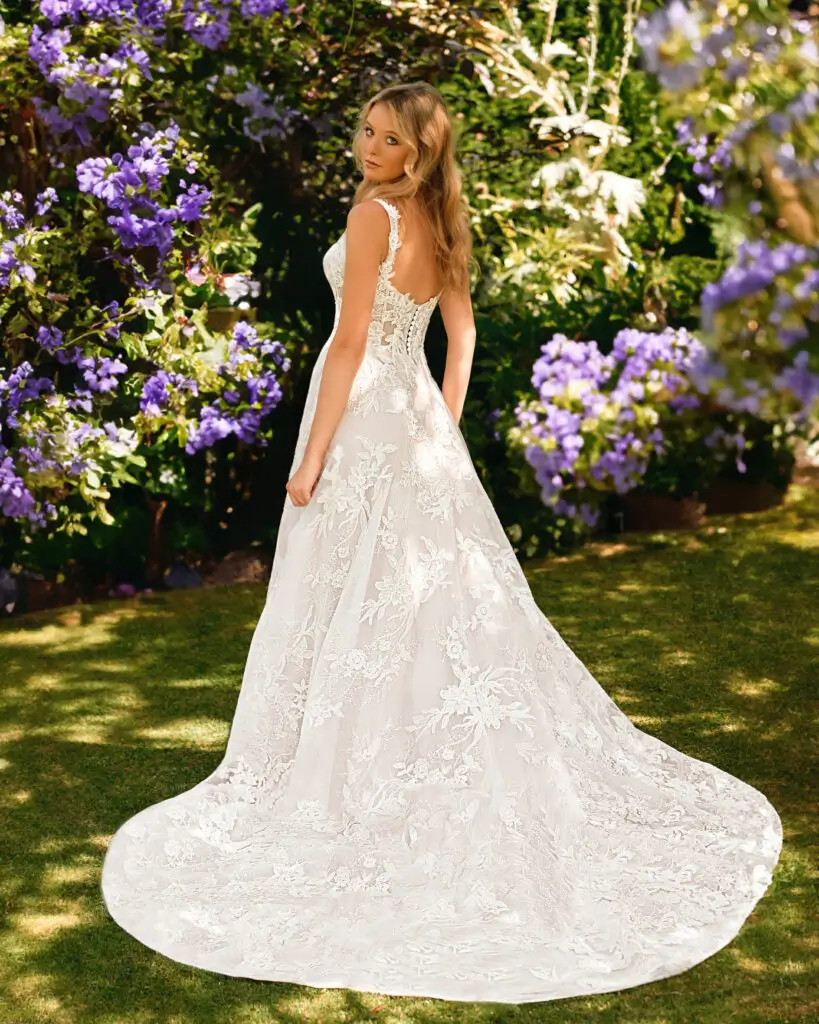
The same applies to A-line gowns. One can skim gently over the hips, while another creates considerably more volume from the waist.
This is why we look at your overall proportions rather than simply saying a particular body shape should wear a particular style.

What Wedding Dress Is Best If You Want to Disguise Your Tummy?
This is one of the most common concerns brides mention to us.
The instinct is often to choose the loosest dress possible, but more fabric does not necessarily create a more flattering shape.
In many cases, some structure through the bodice and a defined waist can give much better proportions than a gown that simply hangs from the body.
Draping and ruching can work particularly well around the waist and tummy, while a structured bodice can create definition and support. Where the waistline sits is also important. Moving it only slightly higher or lower can alter the whole balance of a dress.
An A-line gown is often a very successful choice because it can define the waist before skimming over the hips and tummy without clinging.
That doesn’t mean every bride who is conscious of her tummy should automatically choose an A-line, but it is often a very good place to start.
What Wedding Dress Works for a Fuller Bust?
With a fuller bust, support and proportion are usually more important than simply choosing or avoiding a particular neckline.
A very low neckline may look fantastic on one bride and feel uncomfortable on another. Equally, a high neckline isn’t automatically more flattering simply because it offers more coverage.
The internal construction of the bodice matters enormously. Cup depth, boning, corsetry and how firmly the gown sits around the body can make the difference between feeling supported and spending your wedding day worrying about your dress.
Strapless wedding dresses shouldn’t automatically be ruled out either. A well-constructed strapless gown can provide excellent support, whereas a dress with straps is not necessarily supportive simply because the straps are there.
It is also about balance. The depth and width of a neckline can visually alter the proportions of the upper body, which is why trying several variations is usually more useful than following a rigid rule.
Do Fitted Wedding Dresses Suit Curvy Brides?
Sometimes they do, and sometimes they don’t.
That may sound less reassuring than saying every silhouette suits everybody, but we think brides deserve honest advice.
A curvy bride with good height and balanced proportions can look fantastic in a fitted or fit-and-flare gown. A defined waist and fitted skirt can really celebrate the natural shape of the body.
However, very fitted mermaid gowns can be harder to get right, particularly when a bride is shorter.
Many mermaid dresses are designed with quite a long fitted section before the skirt begins to flare. If a significant amount has to be removed from the hem, you can lose some of the intended shape and drama of the skirt. The proportions of the gown can then look quite different from the designer’s original image.
It isn’t necessarily being curvy that causes the problem. Often it is the relationship between height, torso length, hip position and where the flare begins.
A fitted gown that starts to soften higher up may work much better than a very low mermaid shape on the same bride.
This is also why trying dresses in person matters. Looking at a gown on a six-foot model online doesn’t tell you how those proportions will work on somebody five foot three.


Are A-Line Wedding Dresses Flattering on Everyone?
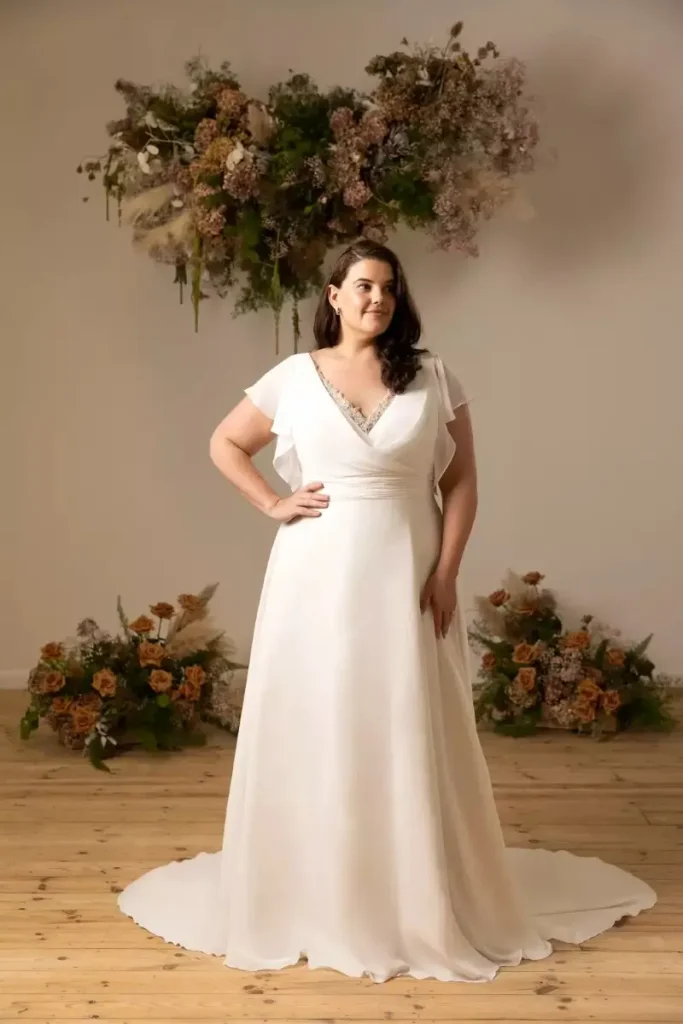
A-line is one of the most versatile wedding dress silhouettes and, in our experience, it suits a very wide range of brides.
There is a reason bridal boutiques often use it as one of the first shapes to try.
It gives definition through the bodice and waist before gradually widening towards the hem, which can create balanced proportions without the restriction of a very fitted skirt.
But even A-line dresses vary enormously.
A soft chiffon A-line can fall very close to the body, while a structured mikado gown can create a much stronger silhouette. Some dresses begin to widen immediately from the waist, while others stay closer through the hips before opening out.
So although A-line is often a very reliable choice, finding the right A-line is still important.
What Wedding Dress Is Best for a Petite Bride?
For petite brides, proportion becomes particularly important.
There is no rule saying a shorter bride cannot wear a full skirt, a train or a dramatic wedding dress. However, some gowns can simply have too much going on for a smaller frame.
Where the waist sits can make a big difference. A bodice that is too long can visually shorten the legs, while a waistline that sits correctly can create the impression of greater height.
The position of detail matters too. Large lace motifs, very wide skirts or extremely long bodices can sometimes overwhelm a petite bride, while finer detail and cleaner lines may create better proportions.
This is also where we have to be careful with heavily shaped skirts.
With some fitted or mermaid gowns, shortening isn’t simply a case of cutting a few inches off the bottom. If too much length has to be removed, the balance between the fitted section and the flare can change.
That doesn’t mean petite brides cannot wear fitted dresses. It means choosing one whose proportions work with their height.
What Wedding Dress Is Best for a Tall Bride?
Tall brides often have different considerations.
A gown may need additional length, but we also look at whether the bodice itself is long enough and whether the waist sits in the correct place.
Long clean silhouettes can look particularly elegant on a taller frame, and taller brides can often carry dramatic skirts, longer trains and large-scale details extremely well.
However, height alone doesn’t determine the answer. A tall bride with a shorter torso may still need a completely different proportion from another bride of exactly the same height.
Where required, we can also check whether a designer offers additional length when a gown is ordered.
Does Your Height Matter When Choosing a Wedding Dress?
Absolutely, and it is something that isn’t discussed enough in many body-shape guides.
Two brides can wear exactly the same dress size and have completely different results in the same gown simply because one is six inches taller.
Designers create gowns around particular proportions. Where the waist sits, where the hips are shaped and where a skirt begins to flare are all part of the design.
Alterations can achieve a great deal, but they cannot always completely redesign the proportions of a gown without significant work.
That is why we consider height and proportions alongside dress size when helping a bride choose.
Should You Try Wedding Dresses You Don’t Think Will Suit You?
Yes, within reason.
Trying different silhouettes is often one of the best ways to answer the question “what wedding dress suits my body shape?” because wedding dresses can look completely different on the body from the way they look on a hanger or online.
We absolutely encourage brides to try something different, but there is also little benefit in trying endless dresses that clearly aren’t working simply because someone has said you should keep an open mind.
A good bridal appointment is a process.
We might begin with several different silhouettes, see what each one does for your proportions, and then gradually narrow things down.
Sometimes a bride discovers that the fitted dress she thought she wanted doesn’t give her the shape she hoped for, but a softer fit-and-flare does.
Another bride may arrive insisting she wants an A-line and discover that a fitted gown gives her a far better silhouette.
The important thing is understanding why.
What About Wedding Dresses That Make You Look Slimmer?
We know this is something brides search for, and it is also something brides ask us directly.
There is nothing wrong with wanting a dress that makes you feel slimmer or gives you a more defined shape.
Certain design elements can help create that effect.
A well-positioned waistline can change proportions. Vertical seams can lengthen the body visually. Good corsetry can create definition through the waist, while carefully positioned ruching or lace can draw the eye exactly where you want it to go.
But there is no single “slimming wedding dress”.
Often the most flattering result comes from getting the proportions right rather than trying to hide part of the body.
Your Dress Size Isn’t the Whole Story
One of the biggest mistakes with body-shape advice is focusing too heavily on size.
A size 20 bride who is tall may carry a dramatic fitted gown very differently from a size 20 bride who is much shorter.
Likewise, two size 12 brides may have completely different bust, waist and hip proportions.
This is one of the reasons we carry wedding dress samples from size 6 to 28 at The Bridal Affair & Curvy Bridal.
Being able to try a gown closer to your size gives you a much better understanding of how its structure and proportions actually work on your body.
It also allows us to give honest advice rather than simply asking you to imagine how a dress might look.
Don’t Choose Your Wedding Dress from a Body Shape Chart
If you’ve been searching “what wedding dress suits my body shape?”, body-shape guides can be a useful starting point, but they shouldn’t choose your wedding dress for you.
Nor do we believe the answer is simply saying that every bride can wear every style.
The reality is somewhere in between.
Some silhouettes will naturally work better with your height and proportions than others. Some gowns can be altered very successfully, while others lose an important part of their design if too much needs to be changed.
The best way to discover that is to try dresses and understand what each one is doing.
At The Bridal Affair & Curvy Bridal in Easingwold, near York, we want you to keep an open mind, but we’ll also give you honest advice.
You may arrive knowing exactly what you want.
You may arrive having absolutely no idea.
Either is fine.
Our job is to help you understand which shapes and proportions work for you, and ultimately find the wedding dress in which you feel at your absolute best.
Frequently Asked Questions
What wedding dress style is most flattering?
There isn’t one silhouette that is most flattering on everybody. A-line dresses work well for a very wide range of brides, but height, bust, waist position, hip proportions and the construction of the gown can all affect the result.
What wedding dress is best if I carry weight around my tummy?
A structured bodice with a defined waist and a skirt that skims rather than clings is often a good starting point. A-line gowns can work particularly well, while ruching and carefully positioned detail can also help create a balanced silhouette.
Can plus-size brides wear fitted wedding dresses?
Yes, but dress size isn’t the only consideration. Height and proportions can be just as important. Fitted and fit-and-flare gowns can look fantastic on curvy brides, while very low mermaid shapes can sometimes be more difficult, particularly on shorter brides where substantial shortening can alter the intended proportions of the skirt.
What wedding dress is best for a large bust?
Good internal structure is essential. Rather than automatically choosing a particular neckline, look at how the gown supports the bust, where the neckline sits and whether the overall proportions feel balanced.
Does height affect which wedding dress will suit me?
Yes. Height can affect where a gown’s waist, hips and skirt flare sit on your body. This is particularly important with fitted and mermaid dresses, as significant shortening can sometimes alter the original shape of the gown.
Should I try wedding dress styles I don’t think will suit me?
Yes. Trying different silhouettes is often the quickest way to discover which proportions work best. You don’t need to try everything, but being open to a few shapes outside your original idea can be extremely useful.


